Sequence



Three consecutive tiles from the same numbered suit
Beginner's guide
This guide explains the terms and rules needed to use the Riichi Reveal hand calculator.
A game of Riichi Mahjong is played over a series of hands. During each hand, every player tries to complete a valid winning hand before their opponents.
Each player normally holds 13 tiles. On their turn, they draw one tile and then discard one tile, gradually improving the structure of their hand. A standard winning hand is made from four groups and one pair, using 14 tiles in total.
Completing this structure is not enough by itself. The hand must also contain at least one Yaku, which is a recognised scoring condition. Yaku and point calculation are explained later in this guide.
Winning hands award points. At the end of the game, the player with the most points wins.
Riichi Mahjong uses 34 different tile types. There are four identical copies of every type, producing a complete set of 136 tiles.
The tiles are divided into three numbered suits and seven honour tiles. Each numbered suit contains tiles numbered from 1 through 9.
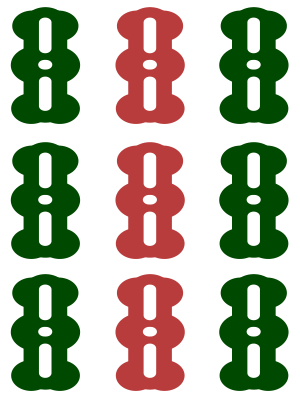
Character tiles numbered from 1 to 9

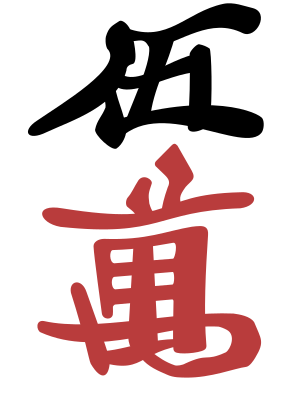



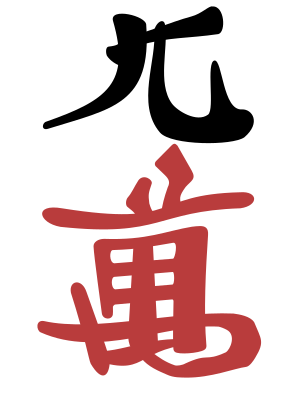
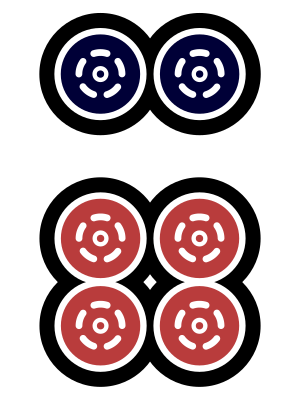
Circle tiles numbered from 1 to 9



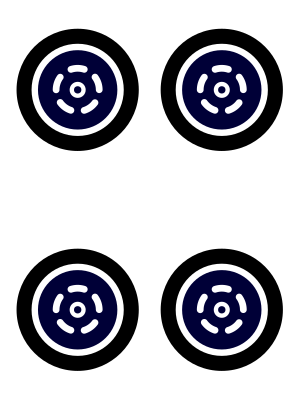
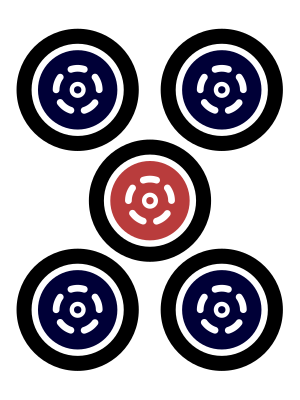


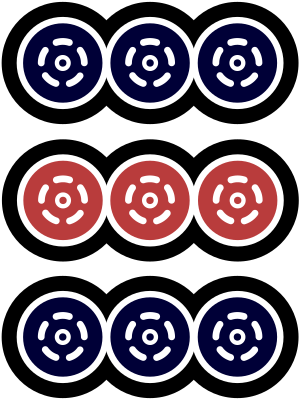
Bamboo tiles numbered from 1 to 9

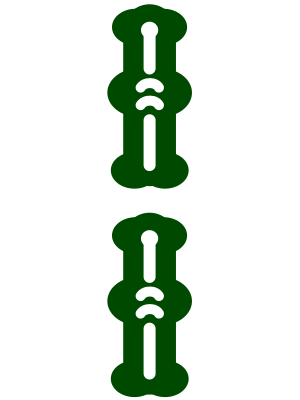
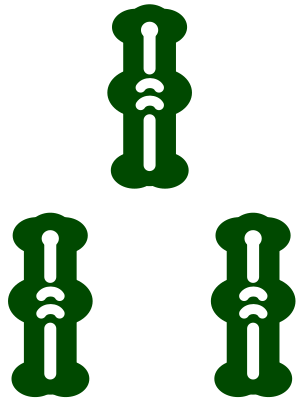
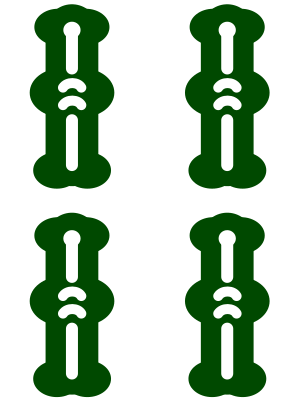
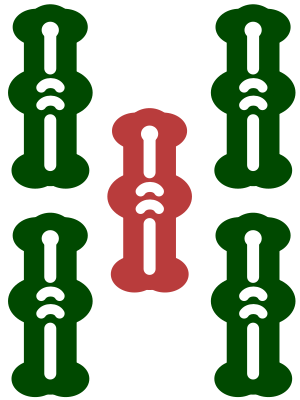
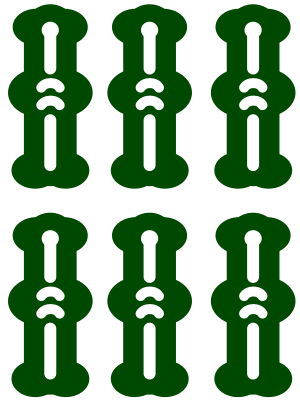
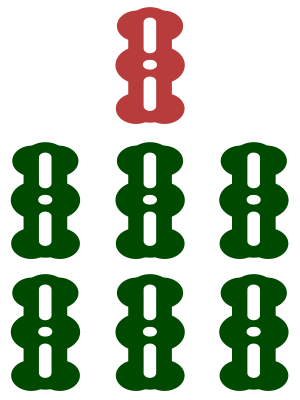

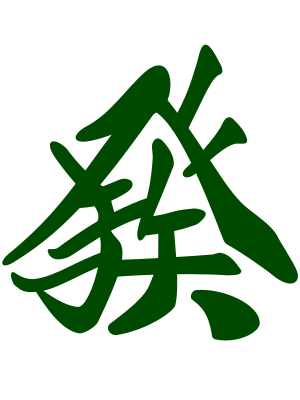
The four winds followed by the three dragons






The 1 and 9 of each numbered suit are called terminal tiles. Tiles numbered from 2 through 8 are called simple tiles. The winds and dragons are collectively called honour tiles and cannot form sequences.
Some Riichi Mahjong sets replace one or more regular five tiles with red bonus tiles. Riichi Reveal follows a ruleset without these red fives.
Before looking at complete hands, it helps to understand the smaller combinations from which they are built.
Three consecutive tiles from the same numbered suit
Three identical tiles
Four identical tiles that count as one group
Two identical tiles
A sequence contains three consecutive tiles from the same numbered suit, such as 2–3–4 of Manzu. Sequences cannot mix suits, contain honour tiles, or wrap from 9 back to 1. For example, 8–9–1 is not a sequence.
A triplet contains three identical tiles. Any numbered tile, wind, or dragon can form a triplet.
A Kan contains all four copies of the same tile. Although it physically contains four tiles, it counts as one group in a complete hand. A Kan must be declared during play, and the player draws a replacement tile afterward.
A pair contains two identical tiles. A standard hand requires exactly one pair alongside its four groups.
Complete hand structures
Four groups + one pair
The groups may be any combination of sequences, triplets, and Kans. This is the most common hand structure.
Most of a Mahjong hand follows a simple cycle: draw one tile, consider the available actions, and discard one tile. Players take turns in counter-clockwise order.
Step 1 of 4
The player draws 7 Pinzu from the wall, temporarily bringing the hand to 14 tiles.
Before the next draw, another player may be allowed to claim the discarded tile:
After calling Chii, Pon, or an open Kan, that player continues the turn and eventually discards. These calls usually make the hand open, which can affect its available Yaku.
A hand normally ends when a player wins by Ron or Tsumo. If the drawable tiles run out before anyone wins, the hand ends in an exhaustive draw.
Every hand starts concealed. It stays concealed while all of its groups are kept hidden from the other players.
Concealed hand
Open hand
A concealed Kan does not open the hand. Winning by Ron also does not turn an otherwise concealed hand into an open hand.
Opening a hand does not automatically give it a Yaku. Before calling a tile, check that the finished hand will still contain at least one Yaku that is allowed in an open hand.
A hand is in Tenpai when it is one tile away from a complete hand. The tiles that can complete it are called its winning tiles, or its wait.
Being in Tenpai does not guarantee that the hand may win. The completed hand still needs at least one Yaku.
The incomplete part of a standard hand can produce five common wait shapes. The wait shape can affect both Yaku and Fu.
Either end completes the sequence: 2–3–4 or 3–4–5.
The missing middle tile completes the sequence.
The only possible tile completes a sequence at the edge of a suit.
Either tile completes one triplet and leaves the other two tiles as the pair.
One matching tile is needed to complete the pair.
You draw your own winning tile. All three opponents contribute to the payment.
You claim another player's discard as your winning tile. The player who discarded it pays the full amount.
The winning tile must complete a valid hand structure and the finished hand must contain at least one Yaku. Which group the winning tile completes can also change the detected Yaku and Fu, so the calculator asks you to identify it.
If any tile in your current wait appears among your own discards, you may not win by Ron on that wait. You may still win by Tsumo. Passing on a legal winning discard can also cause temporary Furiten until your next turn.
Riichi is a Yaku that a player may declare with a concealed hand in Tenpai and at least 1,000 points. The player announces Riichi, places the declaration discard sideways, and pays a 1,000-point stick to the table.
After declaring Riichi, the hand is normally locked: future drawn tiles must be discarded unless the player wins or may legally declare a Kan. The winner of the hand collects the Riichi sticks on the table.
Riichi declared on the player's first turn before a call interrupts the game.
Winning within one uninterrupted turn after declaring Riichi. A call or Kan cancels this chance.
Hidden Dora indicators revealed when a player wins after declaring Riichi. Like regular Dora, they are bonuses rather than Yaku.
Each player has a seat wind; the East-seat player is the dealer. The round wind is shared by all players. A triplet or Kan of your seat wind or the round wind is a Yakuhai. If both winds are the same, the group can fulfil both Yaku.
Winning by Tsumo with the replacement tile drawn after declaring a Kan.
Winning by Ron by claiming a tile used by another player to declare a Kan.
Winning by Tsumo on the final drawable tile.
Winning by Ron on the final discard.